If you are filing or defending a theft case, one of the first questions that arises is about theft jurisdiction in the Philippines—specifically, which court has the authority to hear and decide the case.
Not every court can hear a criminal case. That is because jurisdiction — the legal authority of a court to hear and decide a case — is strictly defined by law. Courts do not assume jurisdiction at will; they may only take cognizance of cases that the law expressly assigns to them.
Quick Answer: Theft Jurisdiction Philippines
In general, theft cases punishable by imprisonment of six (6) years or less are filed in the Metropolitan Trial Courts (MeTC), Municipal Trial Courts in Cities (MTCC), Municipal Trial Courts (MTC), or Municipal Circuit Trial Courts (MCTC).
Theft cases punishable by imprisonment exceeding six (6) years are generally filed in the Regional Trial Courts (RTC).
General Rule on Criminal Jurisdiction
Jurisdiction in criminal cases is generally determined by the penalty prescribed by law. As a rule, the higher the penalty, the higher the court that has authority to hear and decide the case.
How Theft Jurisdiction Is Determined in the Philippines
In theft cases, this general principle takes a more specific form. Under Philippine law, theft jurisdiction follows a clear chain:
Value of property → Penalty under law → Court with jurisdiction
The penalty under the Revised Penal Code, as amended by Republic Act No. 10951, increases depending on the value of the property allegedly stolen. As a result, the value of the property determines the penalty, and the penalty in turn determines which court has jurisdiction over the case.
For purposes of criminal jurisdiction, Philippine trial courts are classified into two levels:
First-level courts – MeTC, MTCC, MTC, MCTC
Second-level courts – Regional Trial Courts (RTC)
MTC Jurisdiction in Theft Cases
First‑level courts have jurisdiction over theft cases where the penalty does not exceed six years. This generally covers theft of property valued up to ₱1,200,000 under R.A. 10951.
RTC Jurisdiction in Theft Cases
Regional Trial Courts have jurisdiction when the penalty exceeds six years. This applies to theft involving property valued above ₱1,200,000.
The infographic below visually summarizes how theft jurisdiction is determined based on the value of the property and the corresponding penalty under R.A. 10951.
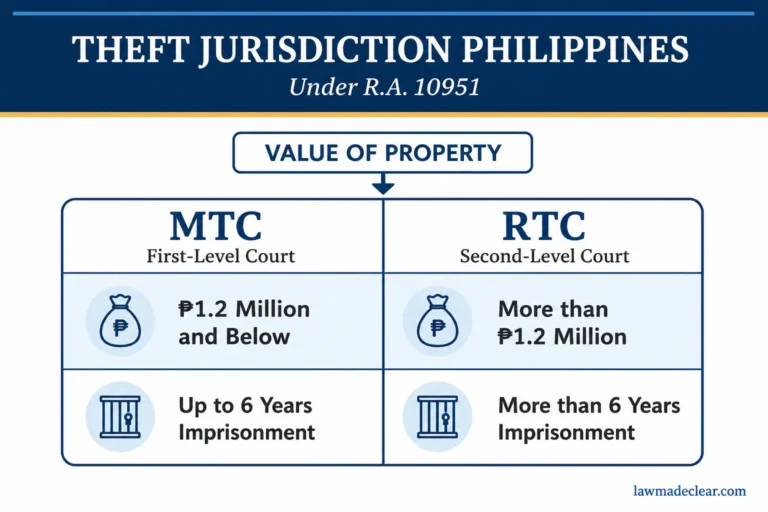
In summary, lower-value theft cases are handled by first-level courts, while higher-value theft cases fall under the Regional Trial Courts depending on the penalty imposed by law.
Thresholds Defining Theft Jurisdiction Philippines
To better illustrate the application of this rule, the following table summarizes the relationship between the value of the property, the penalty imposed under R.A. 10951, and the corresponding court:
| Value of Stolen Property | Penalty (Theft) | Court |
|---|---|---|
| Not exceeding ₱500 — impulse of hunger/poverty | Arresto menor (min) or fine ≤ ₱5,000 Duration: 1 to 10 days |
MTC |
| Not exceeding ₱500 — inclosed premises | Arresto menor or fine ≤ ₱20,000 Duration: 1 to 30 days |
MTC |
| Not exceeding ₱500 | Arresto mayor (min & med) Duration: 1 mo & 1 day to 4 mos |
MTC |
| Over ₱500 to ₱5,000 | Arresto mayor Duration: 1 mo & 1 day to 6 mos |
MTC |
| Over ₱5,000 to ₱20,000 | Arresto mayor (med) to prisión correccional (min) Duration: 2 mos & 1 day to 2 yrs & 4 mos |
MTC |
| Over ₱20,000 to ₱600,000 | Prisión correccional (min & med) Duration: 6 mos & 1 day to 4 yrs & 2 mos |
MTC |
| Over ₱600,000 to ₱1,200,000 | Prisión correccional (med & max) Duration: 2 yrs & 4 mos to 6 yrs |
MTC |
| Over ₱1,200,000 to ₱2,200,000 | Prisión mayor (min & med) Duration: 6 yrs & 1 day to 10 yrs |
RTC |
| Over ₱2,200,000 | Prisión mayor (max) Duration: 10 yrs & 1 day to 12 yrs + 1 yr per ₱1M (capped at 20 yrs) |
RTC |
This is why prosecutors and courts carefully assess the alleged value of the property at the time of the filing of the complaint, as it directly affects the penalty and determines which court has jurisdiction over the case.
Special Types of Theft and Their Effect on Jurisdiction
Aside from ordinary theft, certain forms of theft — such as qualified theft and theft committed through electronic means — are treated differently under Philippine law. In qualified theft, the value of the property remains relevant, but the penalty is automatically increased by two degrees, often placing the case within the jurisdiction of the RTC. In cyber‑theft, penalties are raised one degree higher under the Cybercrime Prevention Act, which can shift jurisdiction to the RTC even when the property’s value would normally fall under a first‑level court.
Qualified Theft
Qualified theft is committed under circumstances specified in Article 310 of the Revised Penal Code, such as when it is carried out by a domestic servant or with grave abuse of confidence.
Because qualified theft carries a penalty two degrees higher than ordinary theft, most cases fall within the jurisdiction of the Regional Trial Courts (RTC). However, when the value of the property stolen is ₱500 or below, jurisdiction remains with the first‑level courts.
Accordingly, jurisdiction in qualified theft cases continues to be determined by the penalty prescribed by law in relation to the value of the property involved, even though the penalty is escalated by law.
Cyber-Theft
Cyber-theft involves theft committed through electronic means, such as hacking, phishing, or unauthorized access to bank accounts or digital systems.
Under the Cybercrime Prevention Act, crimes committed through information and communications technology are penalized one degree higher than the corresponding traditional offense. Because of this increased penalty, cyber-theft cases generally fall under the jurisdiction of the RTC, often designated as cybercrime courts.
Territorial Jurisdiction: Where Should the Case Be Filed?
Aside from the penalty imposed by law, the place where the crime was committed is also an important factor in determining jurisdiction.
As a general rule, a theft case must be filed in the court of the city or municipality where the alleged theft occurred.
- If the theft allegedly occurred in Manila, the case should ordinarily be filed in the proper court in Manila;
- If the incident occurred in Cebu City, the case should be filed in the appropriate court there.
Filing a case in the wrong venue may result in the dismissal of the complaint or its transfer to the proper court, depending on the circumstances and the stage of the proceedings.
Summary
Jurisdiction over theft cases in the Philippines is determined by the penalty prescribed by law, which is influenced by the value of the property allegedly stolen. If the maximum penalty is six (6) years or less, the case falls under the jurisdiction of first-level courts (MeTC, MTCC, MTC, or MCTC). If the penalty exceeds six (6) years, jurisdiction lies with the Regional Trial Courts (RTC).
Special circumstances may affect this rule. For instance, qualified theft carries higher penalties due to the presence of aggravating circumstances, while theft committed through electronic means is penalized under the Cybercrime Prevention Act, which imposes a penalty one degree higher than ordinary theft.
Understanding these thresholds is essential for determining the proper court, since a court must have jurisdiction before it can validly hear and decide a criminal case.